Location: Prijedor
The Keraterm camp was established on 24 May 1992 by decision of the Prijedor Crisis Staff on the site of a pre-war ceramics factory. According to the judgements of the International Criminal Tribunal for the former Yugoslavia (hereinafter: ICTY), more than three thousand Bosniak and Croat civilians passed through the camp, and 371 persons were killed.
Milomir Stakić, President of the Crisis Staff of Prijedor Municipality, was sentenced by the ICTY to 40 years’ imprisonment for his key role in establishing the system of persecution, including the Keraterm, Omarska, and Trnopolje camps.
The camp was closed in August 1992, and the remains of those killed were exhumed from several mass graves in the Prijedor area.
Alongside Omarska and Trnopolje, the Keraterm was among the camps most widely known for atrocities committed as part of the campaign of persecution against the non-Serb population. According to the results of the 1991 census, Prijedor Municipality had a population of 112,543, of whom 43.9% were Bosniaks, 42.3% Serbs, and 5.6% Croats. According to the 2013 census, Bosniaks accounted for 32.5% of the population, Croats 2%, and Serbs 62.5%, indicating a changed ethnic structure of the population after the war.
Camp detainees were held in inhumane conditions, often without food, water, or basic hygiene. An atmosphere of terror prevailed in the camp, arising from constant humiliation, harassment, and psychological abuse, which caused severe physical and psychological trauma to those who witnessed these events.
The suffering of detainees in the Keraterm camp was described as intense, continuous, and systematic. Beatings and rapes were often carried out also by persons who were not members of the camp staff, although it is important to note that sexual violence in Keraterm was less documented than in Omarska.
According to some of the testimony before the ICTY, a female detainee from Keraterm told Witness K that she had first been raped in the Keraterm office by Nedeljko Timarac and then by other men throughout the night. She was then taken outside and told to sit on a rock, beside which a guard later passed and kicked her.
The largest number of killings was recorded during the night of 23/24 July 1992, when around 200 detainees were killed in the so-called Room 3. The ICTY judgement in the case of Sikirica et al. states:
At around 3 or 4 p.m., the Room 3 detainees were put back in the room and the doors were locked. Soon thereafter, some gas was thrown into the room. Some of the prisoners attempted to break down the door and it was then that the soldiers responded with a burst of gunfire. According to several witnesses who survived the Room 3 massacre, there were repeated bursts of gunfire. Several people ahead of Witness N, who was near the door in Room 3, were hit with bullets and three or four of them fell on top of him. (…) The dead and wounded, approximately 160 to 200 men in total, were taken away in a truck.
None of those whose bodies were removed that morning were ever seen again.
A total of nine persons have been convicted for crimes committed in the Keraterm camp, seven before the ICTY and two before the Court of Bosnia and Herzegovina.
Although there have been several judicial proceedings concerning the Keraterm camp, those convicted were predominantly perpetrators found responsible under command responsibility, while certain direct perpetrators remain at large.
For crimes committed in the Keraterm camp, Duško Sikirica, Damir Došen, Dragan Kolundžija, and Zoran Žigić were convicted before the ICTY and sentenced to a total of 48 years’ imprisonment.
Duško Knežević was sentenced by the Court of Bosnia and Herzegovina to 31 years’ imprisonment.
Among the survivors of the horrific torture in the Keraterm camp is Fikret Alić, who appeared on the cover of Time magazine as a detainee from Trnopolje and is known as the “man behind the barbed wire”, and who spent a period of time in Keraterm. Today, he says that he cannot visit the Prijedor camps without taking sedatives. Mirsada Džolić, who herself had been detained in the Trnopolje camp, lost her husband Husein in Keraterm, where he was killed at the age of 32. In addition to her husband, she lost 28 family members and is still searching for her father’s remains.
In front of the former Keraterm camp there is today a memorial plaque erected by former detainees and family members of victims, and as such it cannot be regarded as an official form of memorialisation. The city authorities in Prijedor do not permit any memorial dedicated to the murdered residents of Prijedor. The absence of any response by the competent authorities, even three decades after the horrific crimes committed in Keraterm, further deepens the suffering and trauma of victims and their families.
Photo: „Keraterm Camp, drawing by witness Jusuf Arifagić, Exhibit No. S277B, 28 August 2002, Prosecutor v. Milomir Stakić, IT-97-24. Part of the Judicial Archives of the IRMCT, courtesy of the IRMCT.”
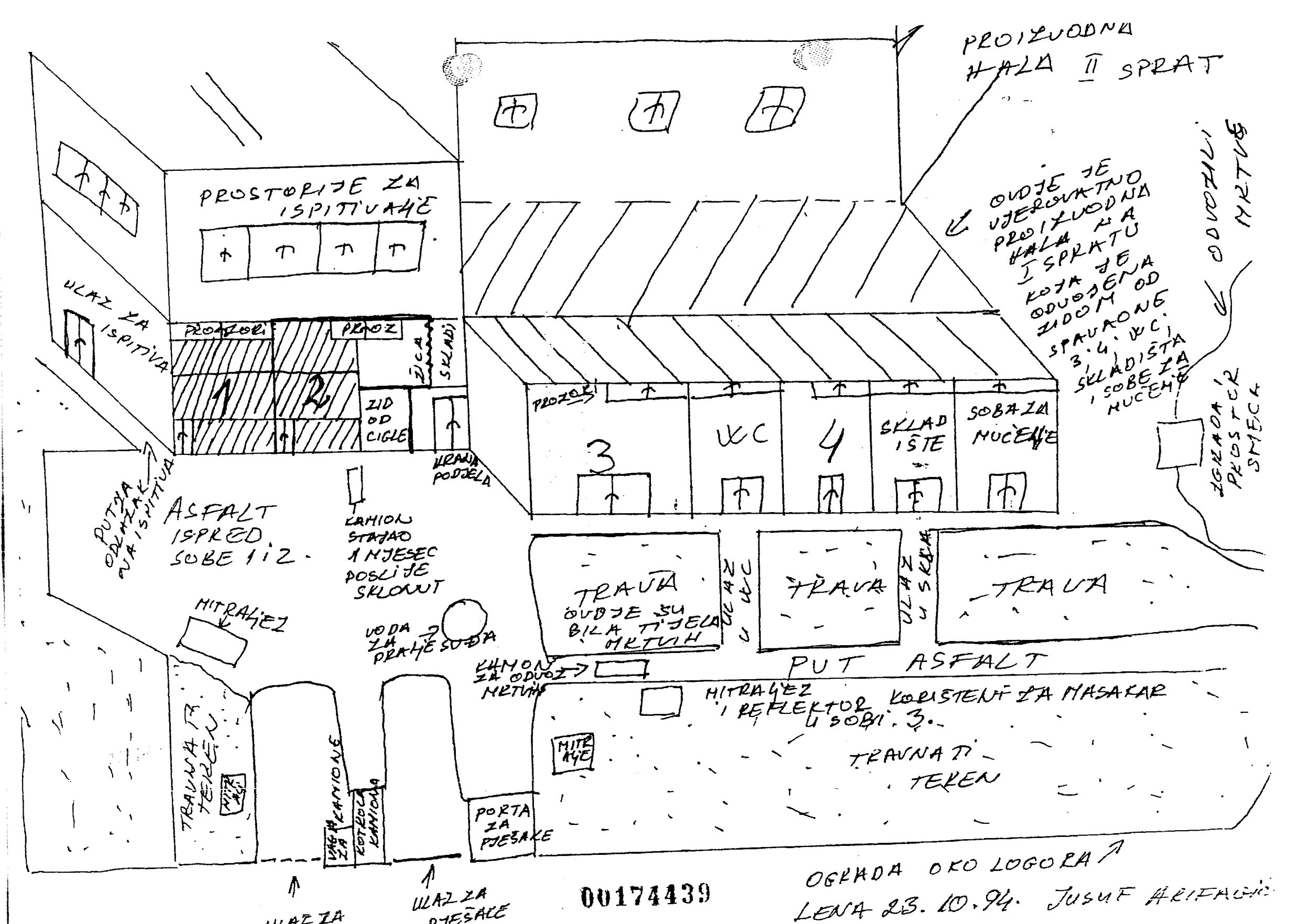
Note: During his testimony, Arifagić noted that the sketch contained one error; room 3 should be where the toilet is and vice versa.